Fact: Only 4% of the SaaS start-ups see the light of the day.
Which is one strongest workflow element in establishing product-market fit?
In this period due to multiple marketing iterations, the best attribution formula that works for you is crystal clear. This is about identifying the best distribution work-flow and more. This goes parallel in acquiring the top 100 paid customers. (There is dedicated article for marketeers/founders in planning this process.)
Products are built to take advantage of specific acquisition channels. If you think of product and channel as siloed in completely different stages of company development, you’ll end up trying to push a product through a channel that can’t support its distribution. The wrong acquisition channel for a specific product can fatally slow your growth.
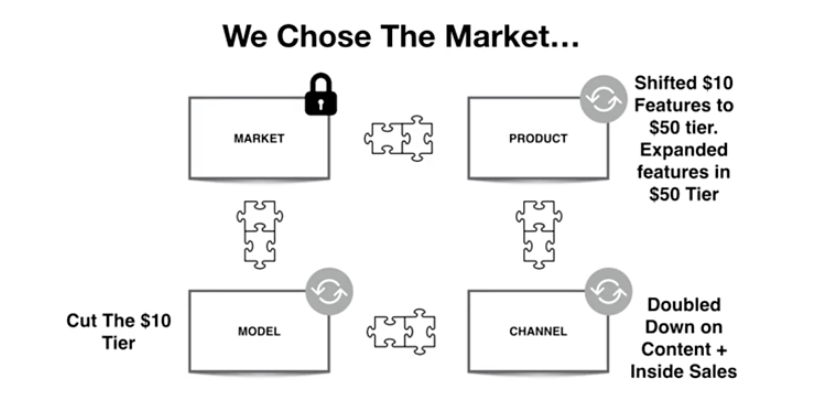
This surge of admirers and customers of your product comes from nurturing the organic channels more than anything else.
How does a founder get signals of a probable success?
This is the phase in the time series when the start-up is done a good testing of the hypothesis. Proven the value to 10x customers. And now the founder wants to understand if this SaaS will be purchased enough to sustain the business in the long run. Because, there has been a major marketing /influencing to reach to 100 paying customers.
In principle, a founder now wants to understand that will his efforts for product market-fit actually a success thus a market-product fit.
During the early days when you’re still trying to validate your hypothesis, your top priority is to quickly iterate on your product and positioning. So while collecting quantitative data like engagement metrics and NPS scores is helpful, the most important thing to do at this stage (and indeed, throughout your product’s lifetime) is to talk to your customers.
Here are a few things to look for when collecting quantitative data to measure product-market fit:
- You should see organic and direct growth. Ideally at least 50% of new signups should be coming from direct or organic traffic sources. This means people are telling their friends, and those friends are signing up.
- You should see early users continue to engage. New user churn should flatten significantly after the first week, indicating that users are continuing to find value in your product over time. As you gain more customers and continue analyzing your retention in greater detail, you can optimize your user experience further. Ideally, your first few weeks of churn should look similar to the blue line below:

- You should have early users that love your product or hate it. The worst feedback you can receive about your new product is a tepid “meh,” or even no feedback at all. Tracking NPS scores with early adopters—and following up directly with detractors (scores of 0 to 6)—can quickly give you insights that will help you improve your product. An overall NPS score above 60 is usually a strong indicator that you’ve found product-market fit.
Interpretations:
- This is another right time to organise and re-organise the marketing work-flows.
- That directs us to look into lead scoring. Let’s make a healthy funnel.
- 100 is a critical number while it is yet to validate the deserving product market fit.
- It being strongly organic, engaging with positive NPS is a phase to create a survey to prove to the potential investors.
This surge of admirers and customers of your product comes from nurturing the organic channels more than anything else.
 Ankita Saikia