While we are trying to fit in the product to market, administering vast activities around sales and marketing is an important area. Even though we understand the logic and importance how to we set things up in a manner that it can transfer the knowledge. For that we must choose the right kind of marketing/sales platform or tool or app. One of such platform which has proven itself in a long run is Salesforce.
In this post I am sharing with you how as a learning SaaS CEO you can structure your activities for PMF.
Once the account is set up for an administrator with a unique email id, it is important to populate the numbers for better result by this beast. One of the significant tab within Salesforce is application eg; Marketing, Sales, Operations etc. And the based on the selected app the corresponding tabs change and become relevant to that job area.
Also within the configuration it is interesting to note that the search made by a consumer will differ from the search by an administrator. From Setup, if Administrator tries to find an item, there can be two options one quick search with is a sub set of a much larger setup search. Setup search can find a term at any position of a sentence or the information of the account.
With so many competing definitions, Product/Market Fit can be difficult to get to grips with; it’s both essential to understand and extremely difficult to do so.
It’s for that reason Sean Ellis (DropBox, Lookout, Eventbrite, LogMeIn…) set out to create a straightforward test to help founders identify the crucial moment when their solution finds Product/Market Fit.
Sean’s simple PMF survey takes a step back from complex metrics, and instead focuses on the most revealing data source at any SaaS company’s disposal: their users.
How would you feel if you could no longer use [product]?
Very disappointed
Somewhat disappointed
Not disappointed (it isn’t really that useful)
N/A – I no longer use [product]
If over 40% of users respond to the survey saying they’d be “Very disappointed” to stop using your product, there’s a great chance your solution has found Product/Market Fit. Why?
After comparing nearly 100 startups, Sean found that those that struggled to reach traction always scored under 40% on this particular test. In contrast, those that managed to gain strong traction always scored over 40%.
Applying this to your business, you have a quick and dirty way of gauging Product/Market Fit.
The simpler a metric is, the more likely it is that people will actually use it.
Even the best-intentioned of tech startups end-up with a huge dashboard of KPIs that look useful, without having any real understanding of how to actually use the metrics to help their business grow.
The Sean Ellis Product/Market Fit test sidesteps this problem – creating a metric that’s easy to calculate, easy to understand, and easy to use.
2) IT’S USER FOCUSED
Despite the perceived complexity of trying to determine Product/Market Fit, at it’s heart, it’s pretty simple: we’re trying to find out if people want our product.
…most startups fail not because they don’t manage to develop and deliver a product to the market; they fail because they develop and deliver a product that no customers want or need.Steve Blank
Sean’s test homes in on the people that engage with your product. Instead of fixating on a ton of quantitative, context-less data, it helps founders touch base with reality, and find out how their users and customers actually feel about their product.
Sometimes we lose track of our customers and instead focus on terms, such as “product/market fit” and if we were in closer touch with our customers we would know whether we have it or not.Leo Widrich, Buffer
What are the cons of Sean Ellis’ Product-Market Fit test?
1) INTENTION =/= ACTION
This is a classic problem with any type of survey, from the Sean Ellis test to Net Promoter Scores (also used as a PMF indicator): there’s almost always a disconnect between what people say they’ll do, and what they actually do.
There’s no guarantee that survey responses, no matter how well intentioned, will actually foreshadow action. If a business bets their entire growth strategy on a single survey, they’re exposing themselves to a whole lot of risk.
While surveys are useful, I would much rather take bets on what people are doing, not what they say they would do or are doing.
This is why I think about these surveys more of as a leading indicator of product market fit vs proof of product market fit.Brian Balfour, Reforge
2) IT INDICATES PMF, BUT DOESN’T GUARANTEE
Sean’s testing revealed that a score of 40% or higher correlates with Product/Market Fit – but as my Stats professor used to hammer into us every lecture, correlation does not equal causation.
A positive score on this test strongly indicates PMF, but it doesn’t guarantee it. The market for your product is going to be nuanced and complicated, and it’s entirely possible for a product to excel at this test, only to crash and burn during the attempt to scale.
KNOWLEDGE IS POWER
Any Product/Market Fit test needs to be viewed as an indicator of PMF, and not proof.
It’s impossible for any test to generate a guaranteed Yes/No, because the question we’re trying to ask is so complicated, and the variables we’re trying to measure change so frequently.
As a result, the more information you have, the more you can de-risk the decision to scale.
Though imperfect, the Sean Ellis Product/Market Fit test plays a huge part in calculating PMF, allowing you to take the pulse of the people that will make or break your business: your users.
Tests for determining Product/Market Fit come in all shapes and sizes, from the super simple to the over-complicated.
Today, we’re looking at the pros and cons of one of the most popular: the approach used by Pardot founder, David Cummings.
1. 10+ customers have signed-up in a short period of time (typically 3 – 9 months). Crucially, these need to be legitimate customers, and not ‘friendlies’ – people with an existing relationship to you, or those trying your product as a favour.
2. You have at least 5 customers actively using the product with little/no product customisation. This means that your product is useful in its current state, and doesn’t require extensive modification to make it useful to each new customer.
3. At least 5 customers have used the product for over a month without finding a bug.
4. At least 5 customers use the product in a similar way, and achieve similar results. It’s common to see early-stage customers using your product in all manner of weird, wonderful and unintended ways – but it’s consistent usage patterns that suggest your product is ready to scale.
5. At least 5 customers exhibited a similar acquisition and onboarding process. In addition to using your product in a consistent way, your customers need to sign-up and start using it in a repeatable fashion using it in a repeatable fashion. It’s these repeatable processes that lay the building blocks for scale.
Successfully achieving each of these 5 goals may seem like a far-reach for some early-stage Startups, and that’s intentional.
Achieving Product/Market Fit is an ongoing process, and not a discrete, big bang event. David’s goals are designed as benchmarks for monitoring progress towards Product/Market Fit. Instead of creating a measurement with a binary output, they provide insights into how Product/Market Fit can be continually developed and improved.
There’s an ongoing maturation process that takes time, even with extended resources. As a founder deep within the process of developing product / market fit, it’s useful to refer back to these five ways to assess progress.David Cummings
PROS OF THE DAVID CUMMINGS PRODUCT/MARKET FIT TEST?
1) IT FOCUSES ON QUALITY OVER QUANTITY
The main reason to determine PMF is to calculate when it’s safe to scale your business. To assess this, your total number of customers isn’t as important as the quality of those customers.
For example, you could have a hundred customers actively using your product; but if they’re each using it in a different way, to achieve different goals, it’ll be almost impossible to scale that success.
David’s goals focus explicitly on the quality of customer engagement, more so than the volume of customers. In doing so, it makes sure that the essential building blocks of your business – the product’s key functionality, its reliability, and its ability to solve a valuable problem – are ready to scale.
…signing 10 customers that fit your ideal customer profile is more important than signing a large number of random customers in the near-term…
— Customers will always ask for product enhancements, so it’s key that requests align with the entrepreneur’s vision of the future
— Ideal customers are going to be happier customers and happier customers are going to provide testimonials as well as references for future customers.”David Cummings
2) IT’S EASY TO USE
Great metrics need to be easy to use. By focusing on a small sample size, David’s test makes it extremely easy to get a snapshot of progress towards PMF.
There’s no need to dig out a monstrous spreadsheet, or wait for your customer base to swell to triple digits: you can get a rough-and-ready idea of Product/Market Fit in a few minutes.
Better yet, they’re extremely actionable metrics: if you’ve failed at providing a bug-free experience, you need to hone in on product development; if new customers are missing out on tons of functionality, it’s time to improve your onboarding process.
CONS OF THE DAVID CUMMINGS PRODUCT/MARKET FIT TEST?
1) IT’S LESS APPLICABLE TO B2C
Each of David’s hallmarks of Product/Market Fit hinge on the experiences and engagement of 5-10 customers.
Whilst such a small sample size is great for usability, it does mean that the test is most relevant to the B2B sector. This is particularly true for those targeting the Enterprise, where a viable business can built with relatively few high-value customers; and the insights offered by such a small sample size can be useful enough to extrapolate from.
With a much lower Customer Lifetime Value(CLTV), B2C companies need a much larger number of customers to sustain their growth. To make this model more applicable to B2C SaaS businesses, the sample size needs to be increased (it’s been estimated that a 10x sample size is enough to make these tests useful).
With such a small sample size, it’s difficult to extrapolate these findings to learn about the quality of the wider market. Instead, David’s approach does a great job at assessing the second component of Product/Market Fit.
‘Satisfying the market’ goes beyond delivering value to a handful of customers – you need to be consistent and predictable with that value. By focusing on a handful of users, David’s criteria ensure that Startups create value in the right way.
By satisfying each of these five criteria, you can rest assured that your startup is attracting the right types of customers – and crucially, providing value to them in a scalable way.
MYTH #1: THERE’S A MAGIC METRIC FOR DETERMINING PRODUCT/MARKET FIT
We can’t calculate Product/Market Fit (PMF) in the same way we can Customer Churn or CLTV.
Your revenue generation plays a part in determining PMF, and so does activation, customer churn, customer success, and a whole host of other crucial SaaS metrics. Even more importantly, these metrics only make sense in the context of your wider business.
The same applies even if you have 100 customers, and they’re generating £50,000 in revenue – you still don’t have a large enough sample size to represent an entire market and draw a significant conclusion.
MYTH #2: WHEN YOU HIT PRODUCT/MARKET FIT, YOU’LL KNOW IT
It’s essential to look for indicators of Product/Market Fit, but you’ll rarely (if ever) negate the uncertainty associated with your calculations.
As Marc Andreesen said, Product/Market Fit isn’t a “discrete, big bang event”: few SaaS startups will achieve the insane levels of growth required for a definite Product/Market Fit realisation.
Instead, it’s more common to see businesses jump closer to PMF in fits and starts: finding traction in small sub-markets, and heading closer to their “good market” bit by bit.
For a real-world example of this in action, check out Marc’s commentary on Joel Spolsky’s Stack Overflow:
He has achieved product market fit in the collaboratively edited Q&A market for audiences such as software engineers and mathematicians.
Is this the primary product market fit? Neither of those markets seem that big.
Will he need significant new features to find the big product market fit?
It’s important to remember that markets change over time. Technology improves, problems change and the needs of buyers evolve.
Even if you’ve achieved PMF in the current market for your product, there’s no guarantee you’ll fit the same market a year’s time, or two, or ten.
Instead of being a one-off, high-five moment, PMF offers an instantaneous snapshot into the performance and fit of your productat a single moment in time.
Achieving Product/Market Fit doesn’t make a product invincible.
A “good market” means a market ripe with opportunity, and in the vast majority of cases, that means competition. Even if your solution achieves PMF, you can still be out-competed by other good-fit businesses.
When you hit Product/Market Fit, it’s time to hit the accelerator. Instead of resting on your laurels, you need to ramp-up your sales, marketing and customer success, and beat all of the other good-fit businesses to the punch.
Even if you manage to capture the lion’s share of the market, changes in technology can quickly render your solution obsolete.
It’s the classic Innovator’s Dilemma: your once disruptive solution gets unseated by a newer, more disruptive upstart.
The only way to survive is to hit Product/Market Fit, and accelerate; to watch for changes in the market, hit Product/Market Fit again, and accelerate; over and over again.
Today, we’re taking a software-specific look at one of the most essential KPIs your SaaS solution needs to understand – and discovering four reasons your success depends on the near-mythical concept known as Product/Market Fit.
There are dozens of competing interpretations around, but for a good starting point, we can’t beat the original definition:
Product/Market Fit means being in a good market with a product that can satisfy that market.
In other words, Product/Market Fit (PMF) is a way of assessing:
The ability of a market to sustain your business.
The ability of your product to meet the needs of that market.
In simple terms, a goodmarket is an expanding market, capable of supporting your business now and into the future; a badmarket is contracting.
We’re also talking about the specific market for your solution (say, the market for CRM solutions) – not the sector/industry that market resides in (the software or technology sectors).
Why does product-market fit matter for a SaaS company?
1) PRODUCT/MARKET FIT CHANGES YOUR PRIORITIES
Prior to PMF, your priority needs to be product development.
You’ll be operating on a lot of assumptions, and as you learn more about the market for your SaaS solution, you’ll need the flexibility to reshape (and even pivot) your product appropriately.
Investments into sales, marketing and customer success should be used to test those assumptions, and experiment – not to actively scale-up your business.
After achieving PMF, your priorities will change.
You’ll have solid indicators that the market can support your business, and that your product effectively solves an important problem.
You can begin to think about securing growth capital, and ramping up your growth investments:
If you decide to scale-up a SaaS company without proven Product/Market Fit, you’re taking a huge risk. There’s no guarantee that a market for your product exists. Even if it does, it might not be able to sustain your business.
Without PMF, major investments into marketing, sales and customer success are premature.
No amount of sales & marketing savvy can sell a product that nobody needs or wants, and when problems appear, it’ll be impossible to determine whether your business is stagnating because of inefficient growth strategies, or because you’ve developed a product that solves a nonexistent problem.
3) POOR PMF CALCULATIONS KILL SAAS COMPANIES
Without a good understanding of Product/Market Fit, many SaaS businesses prematurely shift capital away from engineering and development, and into growth.
Even if they’re able to secure customers, those customers will be paying for a solution that doesn’t meet their needs, and in many cases, having to battle with systems that don’t scale properly.
Instead of being a boon to growth and profitability, the decision to scale can cripple a SaaS business. This can serve to damage its reputation – even burdening it with an influx of customer complaints and generating tons of refund requests.
4) MARKETS CHANGE, AND YOU NEED TO CHANGE WITH THEM
A new solution achieves PMF, and manages to capture the lion’s share of the market.
They become the dominant player, and stay that way, until new technology appears and supersedes their solution.
By failing to stay ahead of changing technology, the incumbent company loses marketshare to a smaller, disruptive business, who in turn, go on to dominate the market.
Rinse and repeat.
In this narrative, the market for a product evolved over time, and the definition of Product/Market Fit changed with it. As a result of developing technology, a solution that fits the market in the here-and-now might not fit the same market in the future.
PMF is like an ongoing health check for your business, allowing you to periodically test the key assumptions that underpin your business:
Does the problem we solve still exist?
Is the problem important enough?
Is the market for our product still a ‘good’ market?
Understanding PMF helps us allocate resources in the short- and medium-term, but it also provides visibility into the future.
Instead of resting on our laurels, we can use Product/Market Fit surveys to provide the impetus we need to continually develop and grow – no matter how the market develops.
Fact: Only 4% of the SaaS start-ups see the light of the day.
Which is one strongest workflow element in establishing product-market fit?
In this period due to multiple marketing iterations, the best attribution formula that works for you is crystal clear. This is about identifying the best distribution work-flow and more. This goes parallel in acquiring the top 100 paid customers. (There is dedicated articlefor marketeers/founders in planning this process.)
Products are built to take advantage of specific acquisition channels. If you think of product and channel as siloed in completely different stages of company development, you’ll end up trying to push a product through a channel that can’t support its distribution. The wrong acquisition channel for a specific product can fatally slow your growth.
Fig: Thought process behind creating a robust marketing workflow
This surge of admirers and customers of your product comes from nurturing the organic channels more than anything else.
How does a founder get signals of a probable success?
This is the phase in the time series when the start-up is done a good testing of the hypothesis. Proven the value to 10x customers. And now the founder wants to understand if this SaaS will be purchased enough to sustain the business in the long run. Because, there has been a major marketing /influencing to reach to 100 paying customers.
In principle, a founder now wants to understand that will his efforts for product market-fit actually a success thus a market-product fit.
During the early days when you’re still trying to validate your hypothesis, your top priority is to quickly iterate on your product and positioning. So while collecting quantitative data like engagement metrics and NPS scoresis helpful, the most important thing to do at this stage (and indeed, throughout your product’s lifetime) is to talk to your customers.
Here are a few things to look for when collecting quantitative data to measure product-market fit:
You should see organic and direct growth. Ideally at least 50% of new signups should be coming from direct or organic traffic sources. This means people are telling their friends, and those friends are signing up.
You should see early users continue to engage. New user churn should flatten significantly after the first week, indicating that users are continuing to find value in your product over time. As you gain more customers and continue analyzing your retention in greater detail, you can optimize your user experience further. Ideally, your first few weeks of churn should look similar to the blue line below:
You should have early users that love your product or hate it. The worst feedback you can receive about your new product is a tepid “meh,” or even no feedback at all. Tracking NPS scores with early adopters—and following up directly with detractors (scores of 0 to 6)—can quickly give you insights that will help you improve your product. An overall NPS score above 60 is usually a strong indicator that you’ve found product-market fit.
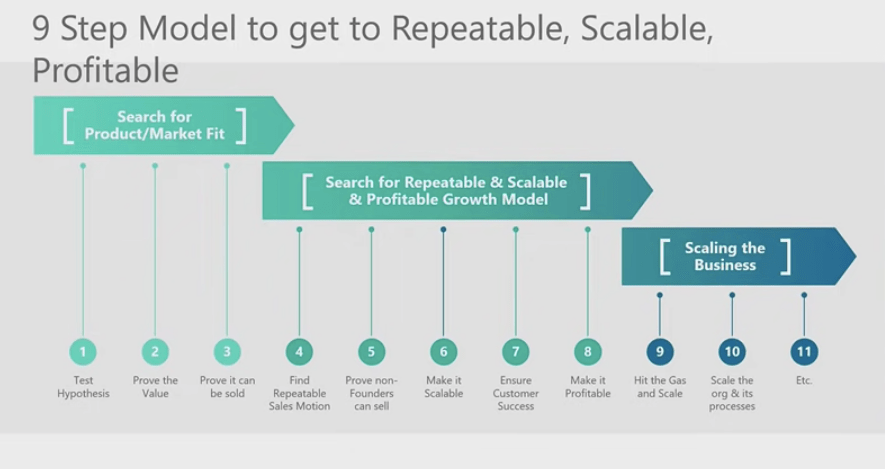
After the very birth a B2B SaaS start-up and before the whole sales motion can be automated by a team of sales folks, in between everything is about product-market fit. It is mostly lead by the founder sometimes with a trailblazing sales person. Below is explained by David Skok.
Does it begin with successful testing of your hypothesis?
“A value hypothesis is an attempt to articulate the key assumption that underlies why a customer is likely to use your product … Identifying a compelling value hypothesis is what I call finding product/market fit. A value hypothesis addresses both the features and business model required to entice a customer to buy your product. Companies often go through many iterations before they find product/market fit, if they ever do.”, Andy Rachleff, co-founder and CEO of automated investment service Wealthfront.
How does successful SaaS start up connects between validating your SaaS idea to the first set of customers?
This framework can be customised to the start-up’s need. While presence of the below elements are expected to make a SaaS business market-product fit when it starts from mare spread-sheet level.
A
B
C1
D1
E
F
Problem statement of prospect
what type of solutions they expect in terms of budget/time/ease
SaaS Product features (top 3)
Does it have a network effect (B2B or 2C)
imitability by the vendor or competitor
Ease of Exit
“pain” point not supplementary requirement. The same pain that made many other businesses suffer recently.
Phase 1: Rising from zero to 1 or first 3 customers.
Phase 2 spreadsheet columns (10 customers or less plus a battle for sustenance). It comes from the real-time iteration with the users and also with slipped leads.
C1.1
D1.1
G
H
I
J
Re-articulate top list of features based on the flow of feedbacks
Micro segments of user groups 1-2-3-4
Value each client user group/micro-segment is bringing to the table
Ease to measure each feature of segments scale – by the scale created by you- with advise to improve on that space
what can be offered free to trade in dependencies
ARR/MRR
Phase 1: Rising from 1 to 10
Early adopters are often the product’s biggest fans (customers 1 to 10x) and are the most willing to provide feedback and criticism about how you can best meet their needs.
If you’re still validating your initial idea and only have a handful of customers, you can reach out to them individually. Just a few calls as early as you can will give you critical insights into your customers’ needs and how your product can be improved to provide a better solution.
[Having 10 unaffiliated customers] means you built something real. Something valued. Most importantly, something you can build on. These 10 customers will give you a roadmap, feedback, and indeed, the path to 1000 more customers—if you listen carefully. Don’t take all their advice, of course, don’t get distracted from the big picture. But, the feedback from these first 10 customers won’t be from outliers. It will be transformatively informative.
How to learn and evolve from the first 100 customers?
Once you have a larger customer base (say, 100 paying customers) you can begin sending out customer surveys to determine whether you’ve reached product-market fit. At its most basic, a survey could consist of only one question: “How would you feel if you could no longer use our product?”
The survey could include just 3 potential answers:
Very disappointed
Somewhat disappointed
Not disappointed
If at least 40% of survey respondents answer that they would be very disappointed to lose your product, you have a strong sign of product-market fit. You can also use the opportunity to ask early customers open-ended questions about your product to gain additional insight.
Interpretations:
Test and also trust your hypothesis
Validate from 10x early adapters
Quickly iterate product, marketing and GTM
For all of the above stay in constant communication with your initial paid customers.
Ask about the context (key) to the initial 10x no of customers
To 100x customers ask their context and quantify additional satisfaction rate (Sean Elias Test) and Net Promoter score.
Founders of B2B SaaS companies are uniformly concerned with optimising what’s known asproduct-market fit: the ability and position of a company to serve a large market with a service that satisfies an urgently felt need or desire. Given that having a large, enthusiastic customer base, and products or services to satisfy and delight them, is the foundation of any successful business, this makes sense.
Interpretations:
Compare it with the viral ity of a piece of social-media content
Where viewers are also buying the product or service sold via it
It needs to generate revenue and reach certain marks
What will a start-up do to reach product-market fit?
As a founder you can answer this to yourself by hearting what makes a vlogger’s first/one vlog go viral!! You may conduct multiple surveys while at the core of it how you connect authentically that comes as a result of multiple Marketing iterations. Now, how do we pen this journey?
In principle, you can measure product/market fit with surveys that identify what percentage of your users think your new product is a ‘must-have’. But more often than not, product/market fit is less about hypothetical numbers and percentages, and more about an in-depth and tangible understanding of who your customers are, and how they feel about you and your product. Is it creating organic growth, where people spread the word on their own? Are people willing to pay for your product? If they are, you have product/market fit. The road to product/market fit is often driven by finding customers via word-of-mouth, before you build a marketing engine to scale user acquisition.
As a startup or early-stage company, your product/service will probably satisfy a small segment of the market (hopefully a good market!). As you grow, so will your understanding of the problem you are solving; and with this understanding, your customer profile might evolve.
Interpretations:
Make this phase Market-product fit than product-market fit
Solving exact pain-point which has already gone malign for businesses in the past
You are doing every bit of marketing iteration to make this panacea – faster for technical implementation, price convenience for adoption, easy to use
And importantly measurable for that business.
Create your scale for measurement either for one feature or for the entire solution.
“Product market fit doesn’t feel like vague idle interest. It doesn’t feel like a glimmer of hope from some earlier conversation. It doesn’t feel like a trickle of people signing up. It really feels like everything in your business has gone totally haywire. There’s a big rush of adrenaline from customers starting to adopt it and ripping it out of your hands. It feels like the market is dragging you forward.
I think the Dropbox founders said this best that product market fit feels like stepping on a landmine…when we did find product market fit, I thought for sure, this is too tiny to matter but it actually solved a real problem and the market demanded it and ripped it out of our hands.”





 Your revenue generation plays a part in determining PMF, and so does activation, customer churn, customer success, and a whole host of other
 Even if you’ve achieved PMF in the current market for your product, there’s no guarantee you’ll fit the same market a year’s time, or two, or ten.
 When you hit Product/Market Fit, it’s time to hit the accelerator. Instead of resting on your laurels, you need to ramp-up your sales, marketing and customer success, and beat all of the other good-fit businesses to the punch.
 Without PMF, major investments into marketing, sales and customer success are premature.
 Even if they’re able to secure customers, those customers will be paying for a solution that doesn’t meet their needs, and in many cases, having to battle with systems that don’t scale properly.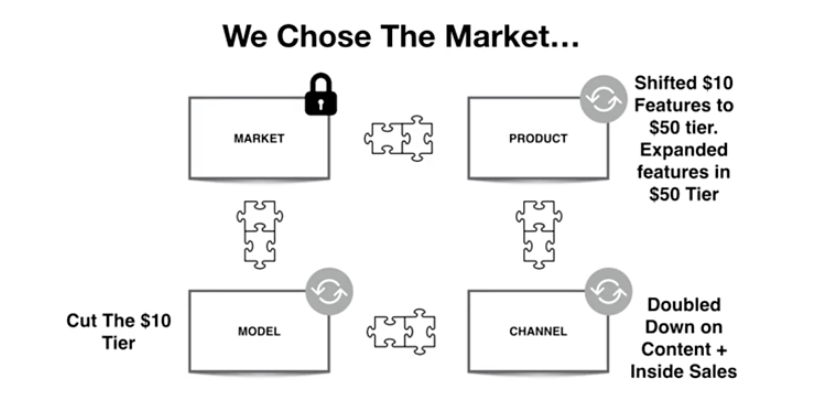


 Ankita Saikia